Amsterdam, Not So Rhine Cruise, & Berlin
Updated: Oct 7
September 23-October 8, 2026
Amsterdam
It’s been a while between blog entries. But now we are off again with our friends, Esta and Jay Feinsod. We always said we would do a river cruise when we’re old. Well, we’re old! We faced this trip with some trepidations since our cruise down the Rhine River is being truncated by the drought. So we board in Amsterdam, get off the boat in Antwerp ( a different itinerary than was planned), get on a bus to Luxembourg then head to Strasbourg where we board another boat to complete the voyage to Basel. Moreover, our friends the Loststein’s who were supposed to join us cancelled, and the train we were supposed to take from Basel to Berlin was cancelled. And we hadn’t even started the trip!
Nevertheless, we arrived in Amsterdam, our jumping off point, with nothing amiss. We are staying at the Amstel Hotel where we stayed many years ago. It’s still a beautiful grand hotel.

Of course, our rooms weren’t ready so we took a long walk to the Albert Cuyp outdoor market featuring cheap clothing and trinkets and trash but also Rudy’s, the best place for the local Stroop waffles—very thin wafers filled with caramel. Very tasty and sticky. Back to the hotel for a lunch in their elegant dining room and then naps for all.
We haven’t been to Amsterdam for years, but while much is the same a lot is different. Coming in from the airport, it’s all very modern buildings and high-rises. The core of the city is unchanged for the most part—beautiful old buildings, canals (with bridges lit nicely at night) and bikes—thousands of bikes with very few cars on the road. They say that the Netherlands has 18 million bikes, one per person.We have to be very careful not to get run down because the bikers are speed demons. We walked to a very interesting and good dinner at Char.D, passing many, many bars and bistros filled with young people drinking and smoking weed. Retail is not dead here with many small and interesting local retailers lining the streets.
Next morning was sunny and glorious. After breakfast we took a tram to the Rijks Museum which is famous for its Rembrandts , Vermeers, and other old Dutch Masters. Behind a glass barrier we could watch restorers working on Nightwatch, Rembrandt’s huge masterpiece. Fascinating how they remove the varnish and reveal the original oils as Rembrandt painted it. An interesting factoid—if there is a fire, the painting is automatically lowered into a fire-proof vault.

I

Rembrandt’s Nightwatch under restoration. Lacquer removed on section on the right and left.
We Ubered to the Jewish Quarter and the old Portuguese Synagogue. Built in 1675 it was at one time the largest synagogue in Europe. It served the large and prosperous Sephardic community that originally was forced to convert to Catholicism but reverted to Judaism when they left the Iberian peninsula. The synagogue was saved during the Nazi takeover by a Fire Brigade that convinced the Nazis to lock it up and save as a “museum for the Jews who once lived.”However, of the 4300 members of the synagogue who were sent to concentrations camps, only 800 survived. The Synagogue to this day has no electricity and uses candlelight for services still conducted today.


After a bagel lunch we walked back to the hotel, passing the small brass squares in the sidewalks that mark where Jews who were killed in concentration camps once lived. Ironic on a sun-splashed, beautiful day to walk among those who were dealt a horrible fate.
Dinner tonight was at V&A, a recommendation from our friends the Cokins. It didn’t disappoint. Best items were the escargot and an onion parfait thing that was excellent. Fish prevailed for the main course which the others thought was excellent. I had a prepper steak which was just OK.
Next day it was back to the museums, in this case the Van Gogh Museum which was founded by Van Gogh’s nephew Vincent to house his Uncle’s and parents’ collection of Van Goghs as well as other artists they collected. It’s a marvelous museum with some of Van Gogh’s masterpieces and a very good commentary on headsets. We followed it up with a simple and mediocre lunch nearby and then walked back to our hotel to await the car to take us to the dock and our riverboat. Will spend part of tomorrow still in Amsterdam on a boat tour of the canals.
In the afternoon we boarded our riverboat-the Amalea-to begin our cruise. All the riverboats are the same width, narrow enough to go through the locks, but very, very long. When we booked there was a limited supply of rooms, so we gave the Feinsod’s the larger room because they had celebrated an anniversary when we booked; but our room was very tiny. Fortunately, because of the itinerary change, there were some cancellations so we were able to upgrade to a reasonably larger stateroom. End of drama. We enjoyed a nice dinner and met some of the other guests. Most are Americans of a certain age.


We were up bright and early for breakfast and then boarded a bus to take us from Zaandam where the boat was docked and which was once the industrial heartland of Europe in the 16th century to our canal tour in the old town. The “new” town is high-rise apartments and very contemporary buildings. Interesting architecture. The original harbor from which the mighty Dutch trading ships departed in the 16th century of the Golden Age of the Netherlands has been partially filled in to create new land for development. There is a great scarcity of land in the Netherlands which is about the size of Maryland. Indeed, there is a housing shortage of 1million homes in a country of 18 million people.

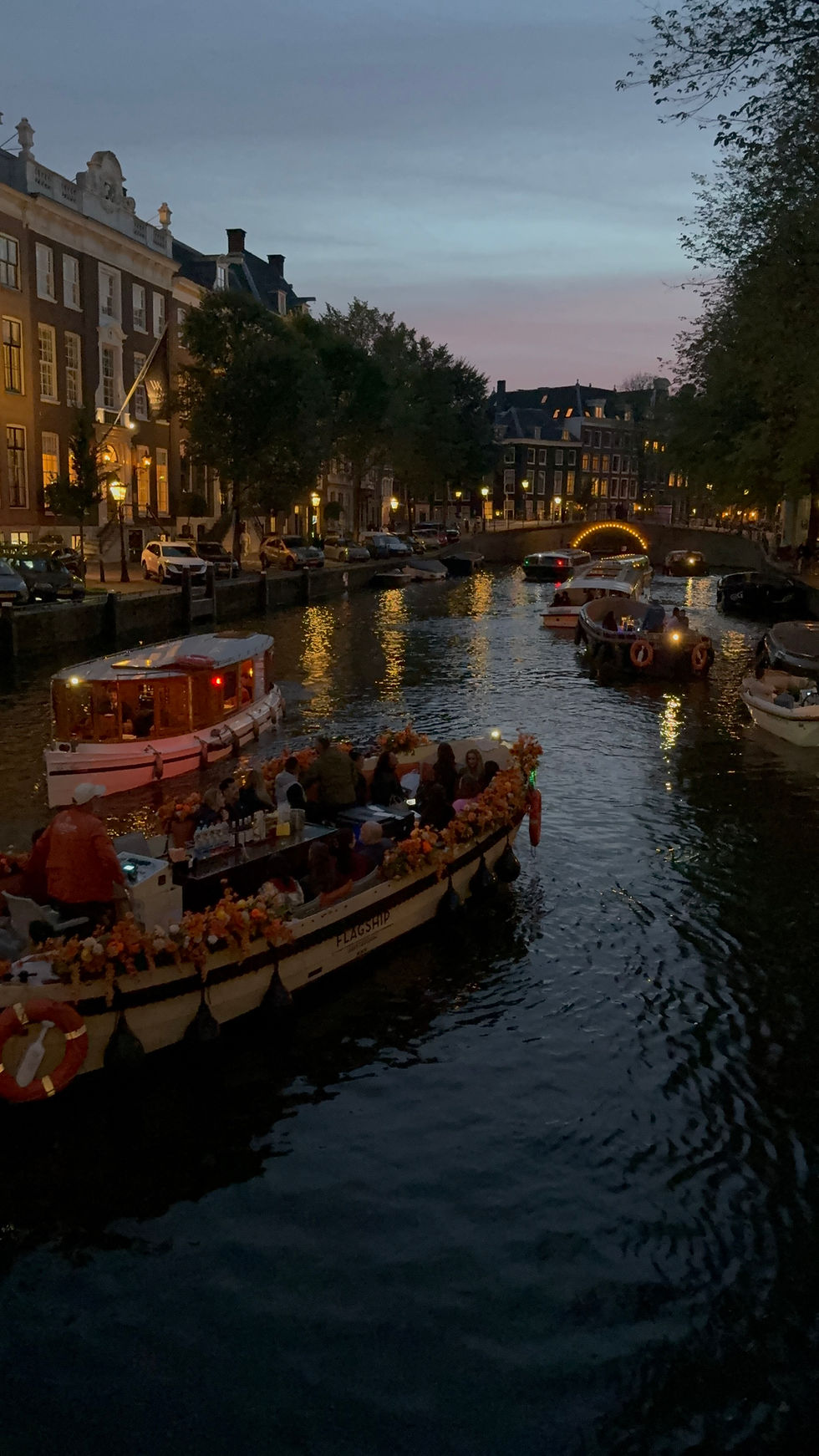
Our canal cruise took us through the more scenic of the 40 or so miles of canals which have 1500 bridges. The old town is a UNESCO site with most of the buildings dating to the 1600’s and built on wooden piles which, when exposed to the air during droughts, can sink leaving the affected houses tilting one way or the other. It’s still a beautiful and scenic city.

We had some time after the boat to wonder in a lovely part of the old town which we had not yet visited near the Rijksmuseum.. Best part was sharing a wonderful fresh cinnamon bun.

Back on board and after lunch we did a mile walk (14 laps) on the boat’s sundeck to burn some calories. We set sail after lunch along a long canal that empties into the Lek, a branch of the Rhine River. We passed bucolic green fields with cows grazing and long rows
of handsome trees in double lines lining the canal and bordering a marvelously long and flat bike lanes. There are 22,000 miles of dedicated bike lanes in the country, perhaps the most in the world.
Antwerp
They say that in Belgium you can get four seasons of weather in one day. Well, we had at least three the next day. We had arrived in Antwerp over night and woke to a cloudy day where it had rained overnight. Then it turned warm and briefly sunny before intermittent light rain for the rest of the day. We are docked in the city on the Schelde River and the second largest harbor. after Rotterdam in Europe. Interestingly, along this river there are no
bridges in Antwerp because on one side was the Belgian/German side (in medieval times) and the other side was French. And since they didn’t like each other they built no bridges. Today there are two car and one pedestrian tunnels so I guess they have gotten over the animosity.
After breakfast, we took a guided walking tour. Betsey and I had been here on our honeymoon as we drove from Brussels to Copenhagen, but that was a long time ago. Yet we remembered the ‘grand Platz” which is very beautiful with a large City hall and guild buildings lining the square.


Antwerp was a major target for the Nazis because of the importance of the harbor, so it’s not surprising that a lot of the city was bombed and buildings destroyed. The architecture therefore is a mix of old buildings dating as far back as the 16th century and modern, not very pretty architecture intermittently dropped into the bombed out sites. Also nearby is Europe’s first skyscraper, built in 1932 as apartments (now offices) in the art deco style


Every major city in Europe has a cathedral and Antwerp is no exception; however, this one includes some Rubens paintings, and he is commemorated with a statue.

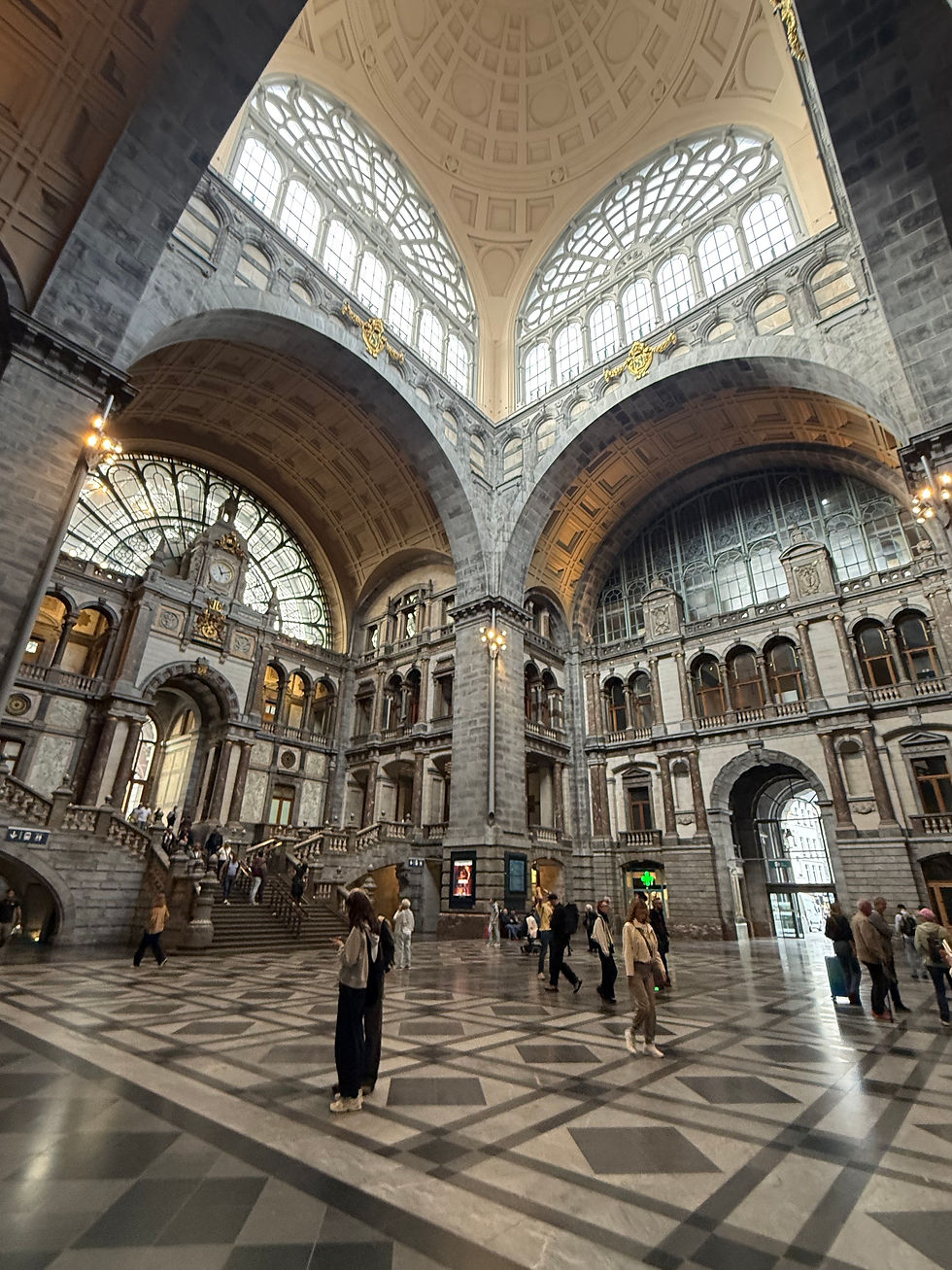
Perhaps the grandest building is the train station, said to be the most beautiful in Europe which is actually pretty impressive.



On the way to the train station we walked along a main shopping street lined with diamond shops. Antwerp is a major exporter of diamonds, think Belgian Congo. Jews, who found most skilled guilds barred to them found that cutting and trading diamonds was accessible, so Antwerp (and Amsterdam) attracted large Jewish populations. In fact, Antwerp has the largest Hasidic Jewish populations in Europe. Out of about 20,000 Jews in Antwerp, 10,000 are Hasidic.
It was lunch time and Chat identified a restaurant for us near the main square, but it was closed. A lucky turn of events since we looked for the first restaurant with tablecloths and discovered Arte,a truly wonderful Italian with fresh made pasta which was delicious. Not quite a taste of Belgium so after an ample lunch we sought out a Frites place, said to be the best. It seems that French Fries are a misnomer. When the Americans were coming from the Battle of the Bulge, they came from French territory and happened upon a village serving Fries. They called them French Fries but they were really Belgium fries. A error that confounds Belgians to this day. The line was too long and we really weren’t hankering for fires after our pasta lunch, but to get a taste of Belgium we stopped at a chocolate store and enjoyed one excellent chocolate for each of us. We stumbled back to the boat, full and tired.

Back at the ship (we had walked at least five miles today) we had dinner (consensus is that food is”ok” on board) and packed. Tomorrow we face a long day of bus rides to transfer to Strasbourg where we will rendezvous with our second riverboat to continue our journey.
Luxembourg
We were up at dawn to get on our long day of busing. Not my favorite mode of travel. But we go with the flow or lack thereof. We are headed to Strasbourg where we will board another riverboat and finally get on the Rhine! But first we had an afternoon in Luxembourg, a country we had not previously visited. Smaller than Rhode Island with 690,000 people of whom 150,000 live in the city of Luxembourg. It is a very beautiful place. The architecture I would describe as a mix of Bavaria and Paris. A fortress built by a king in 963AD is surrounded by the remnants of walls guarding the fortress and now surrounding what was once considered the poor section of the town.


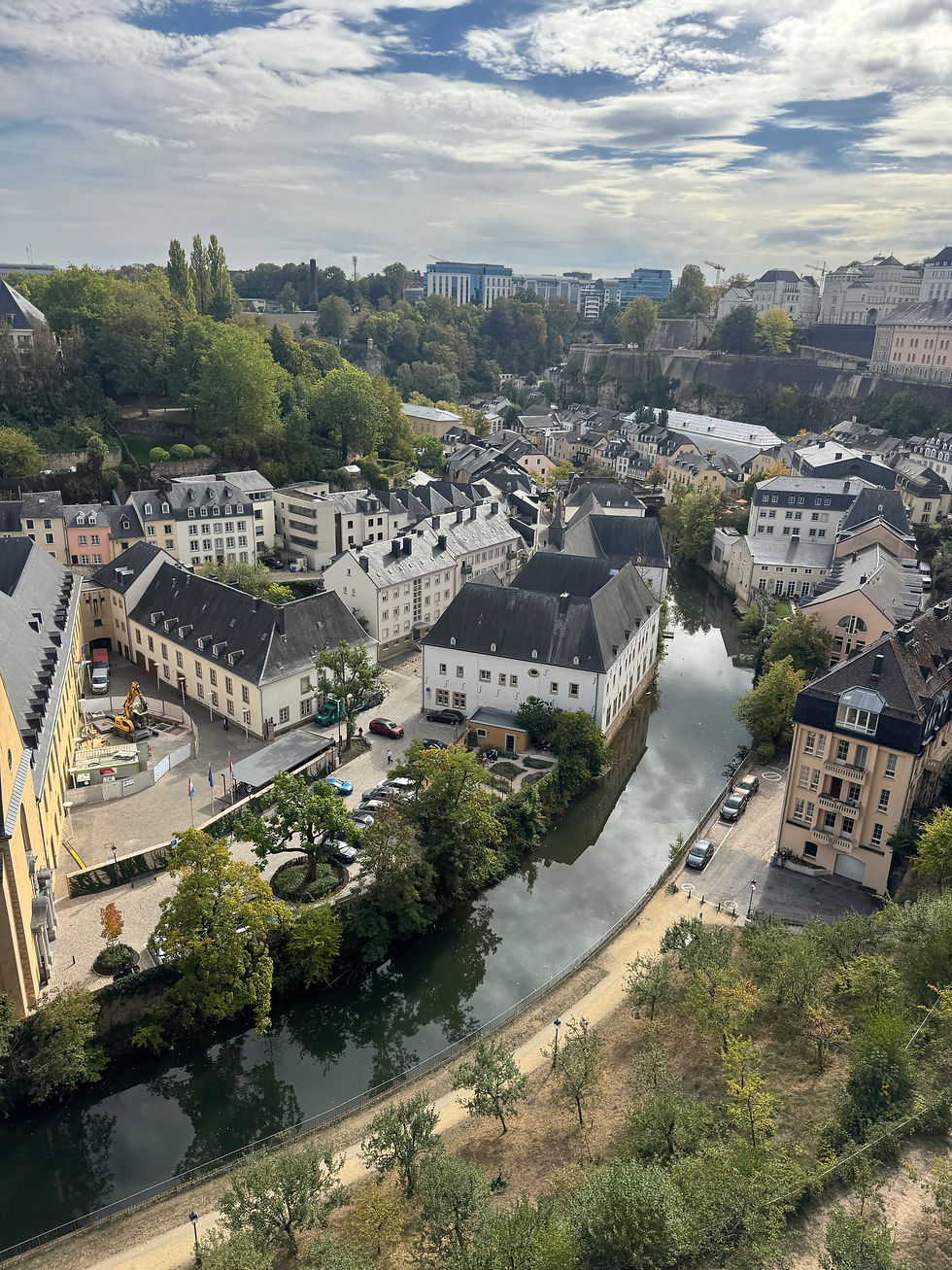
. High up the old city looms with stately medieval buildings, including the palace of the Grand Duke and the City Hall. The country is a duchy with a parliament, and today the President of Finland is here on a state visit. So Finnish flags fly everywhere and the Duke took him to lunch rather than greeting us as Immm sure he would have.

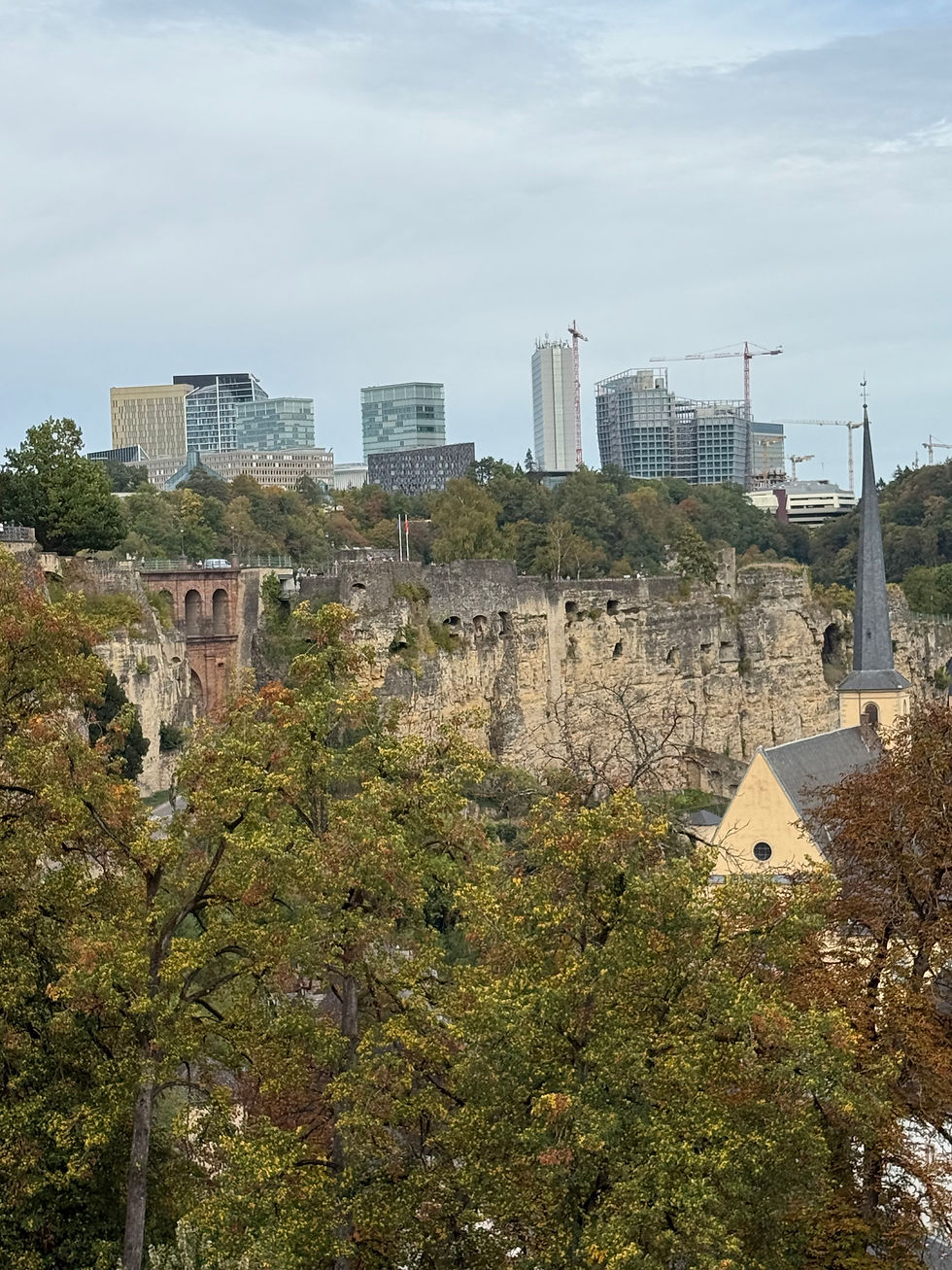
Luxembourg was the first capital of the European Community, and 15,000 Euro employees work here in the modern section of town on another hill. Interestingly, 50,000 workers commute to the city from Belgium, France, and Germany every day. The pay is good, the taxes are low, and there are many jobs available in finance and tech, the current drivers of the economy today in a very wealthy country. Note to Mandami—mass transit here is free to all.
We were very glad to have come here, but soon it was time to move on. We have about four more hours to get to our boat in Strasbourg. At least the bus was reasonably comfortable.
We finally arrived in Strasbourg at 6pm. We have to say that the logistics management of this cruise and the transfers have been superb. It’s been like Swiss clockwork. Anyway, the new riverboat is virtually the same as the old one, and we have an identical room which made it very easy to unpack because we knew where everything went. The only misfortune is that the AC on our floor of the boat is not working well and while they are working earnestly to fix it, I fear a sleepless night. It turned very warm in Luxembourg and now Strasbourg.
Strasbourg
As it turned out I had the best night’s sleep of the trip and the AC started working later in the morning. For today’s excursions we split up. Betsey, Esta, and Jay went on a history walking tour, and I went biking. We had 18 of us biking and a great guide- Jake, a model and guide who was charming and fun. We did about a 13 mile ride into the City through the Orangerie Park, the City’s Central Park. In it is the Josephine Palace, built by Napolean for his Empress who loved the City. Interestingly on the French side of the Park there are many flower beds; on the German side, none. This brings to mind the City’s history. Originally a Roman settlement, since the 16th century it has switched sides five times—from Germany to France and vice versa. The last time was after World War II when it went back to France from Germany.

Josephine Palace

The back and forth from one country to another is reflected in the architecture. There is a section (Petite Francaise) which captures early French residential architecture and then a German area with massive German Neo-Gothic buildings like the library and university buildings. Speaking of university, there are 70,000 students living in Strasbourg today out of a total poplulation of 300,000. So a young and vibrant city as well as a beautiful one.

Petite Francais

German Baroque architecture
A highlight of our bike tour was the Cathedral of Notre Dame. Started in the 12th century, the single spire wasn’t completed until 1439. The second planned spire was never built, primarily because they determined the ground couldn’t support a second spire. The rule was and is that no other building in the old city can be more than half the height the Cathedral so it is visible all over the city. We stopped there for a break and I enjoyed an ice cream.


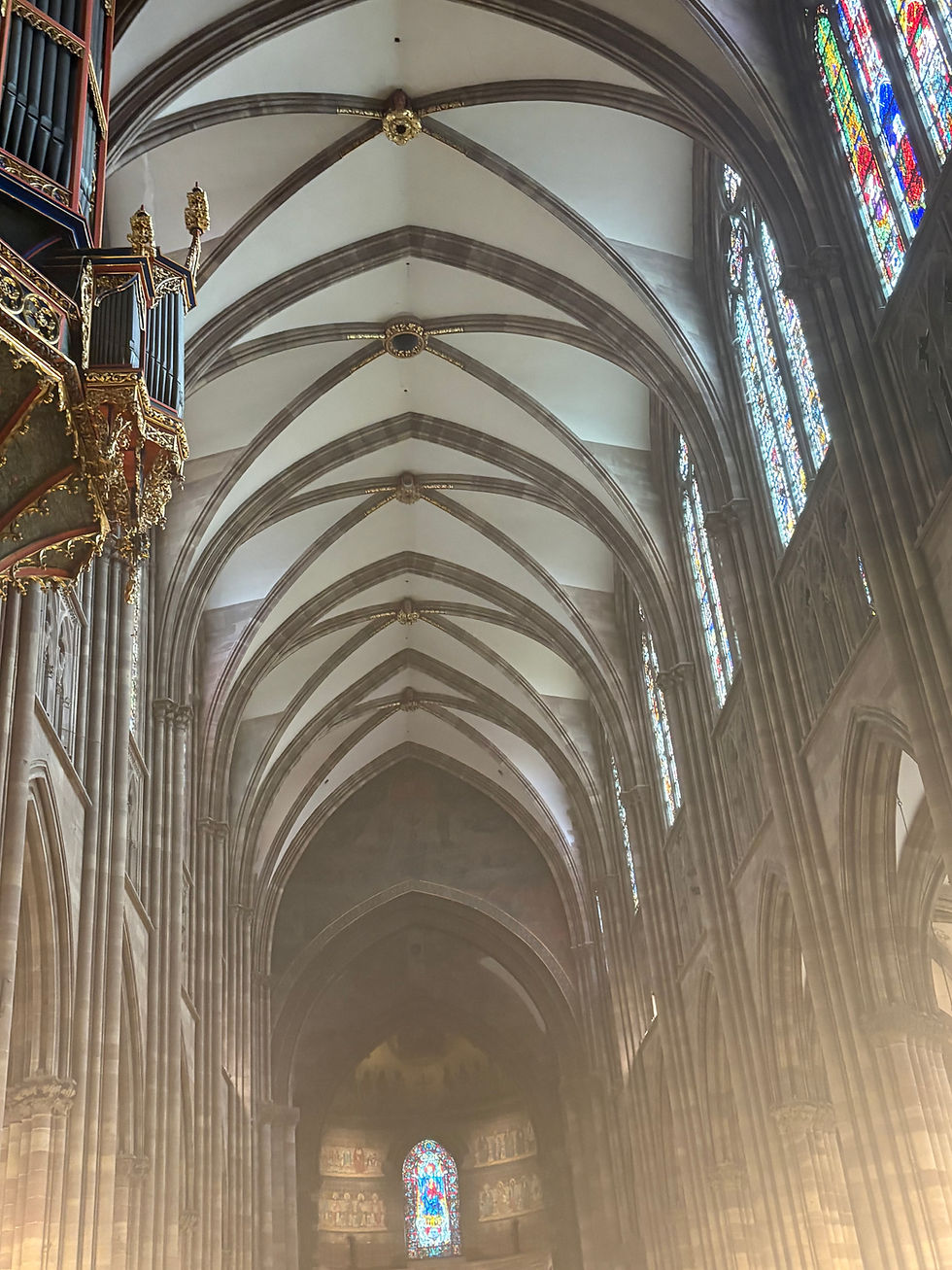


The famous Astronomical Clock dating from the 16th century tells time, positions of the planets, a perpetual calendar, and solar and lunar eclipses.
There is also a modern side of Strausbourg. The City became the second capital of the EU, and the Parliament building and secretariat are very modern. The architect designed the parliament building so the top looks unfinished, symbolizing that the work of Europe remains unfinished. There is also a modern apartment area with shops and one building that was the first building in Europe to generate more power than it uses. They are very sustainability committed here.

We returned from our separate excursions at about the same time and just chilled after lunch on the sundeck. The scenery left much to be desired, sort of an O&G industries if you know Stamford. Very industrial. It was only at our afternoon briefing that the tour director told us that the Rhine is an industrial river so the scenic towns and villages were built more inland. So excursions require busing for an hour or more. The Rhine was not described that way in the brochures, and it is only last night that we actually arrived on the Rhine.
Heidelberg
On a cloudy day with intermittent light rain we took off for a two-hour bus trip (this is getting old) to Heidelberg. We drove through farmland with mountains and the Black Forest in the distance. Heidelberg, itself, is in a valley alongside a river, a scenic setting for what is a university city. Of the population of 160,000, 32,000 are university students, so plenty of beer halls. As part of the old University, there is the student prison which housed misbehaving wealthy students who could easily bribe their jailers to obtain drink and women.


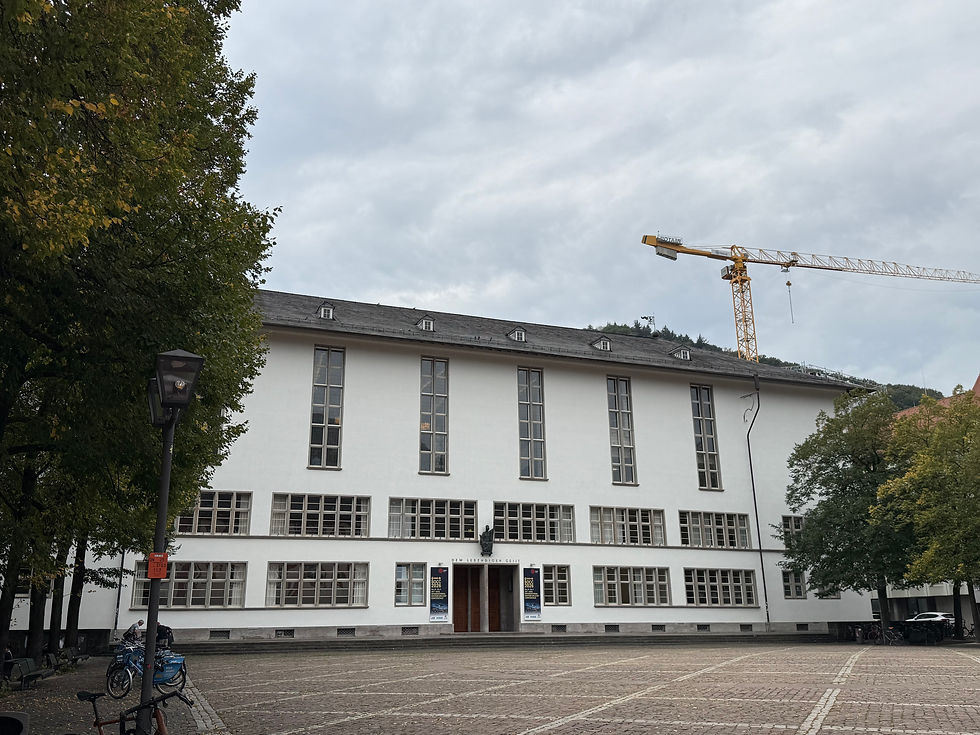
A newish university building was donated by an American former student
Heidelberg was a victim of the 9 years war between the French and Germans at the end of the 17th century. The city was burned to the ground by the French, and the wooden buildings were replaced by stone and stuccoed structures, all in the same, actually sort of dull, functional style. Only one building survived the fires, a large mansion which was built from stone.


In the center of the old town is, of course, the primary church. While the city was Protestant (as is most of Germany), for a period it was ruled by a Catholic branch of the ruling family. So the church interior was divided in the middle—half Catholic and half Protestant , it remained that way until the mid 1930’s. The rather stark interior of the church is in marked contrast with the Notre Dame Cathedral in Strasbourg. Another interesting aspect of the church is that there are market stalls attached to and around the perimeter. That was because the townspeople always felt that they should always be close to the church, even when shopping.


The ruins of a former ruling Prince’s castle loom high on the top of a hill, and there is a good view of it from the main gate into the city.

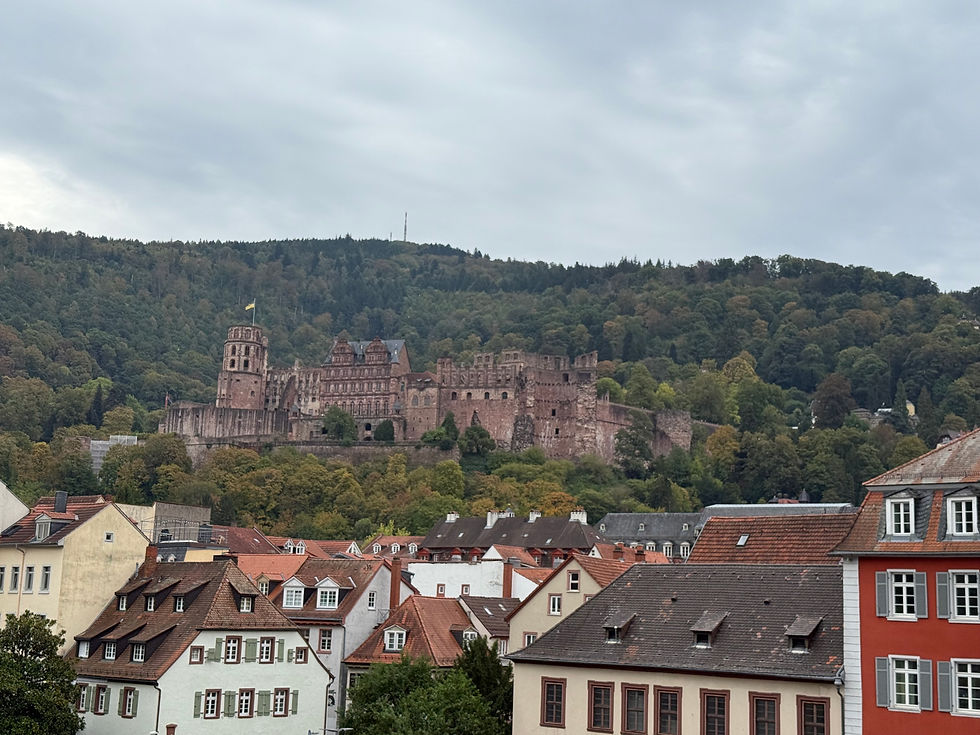
Since the four of us are not much for German food, we had a good pasta lunch at an Italian restaurant and wandered back for the long bus ride back to the ship. Soon after we were back on board ,we set sail. For the first time we are actually on the Rhine.
On the Rhine
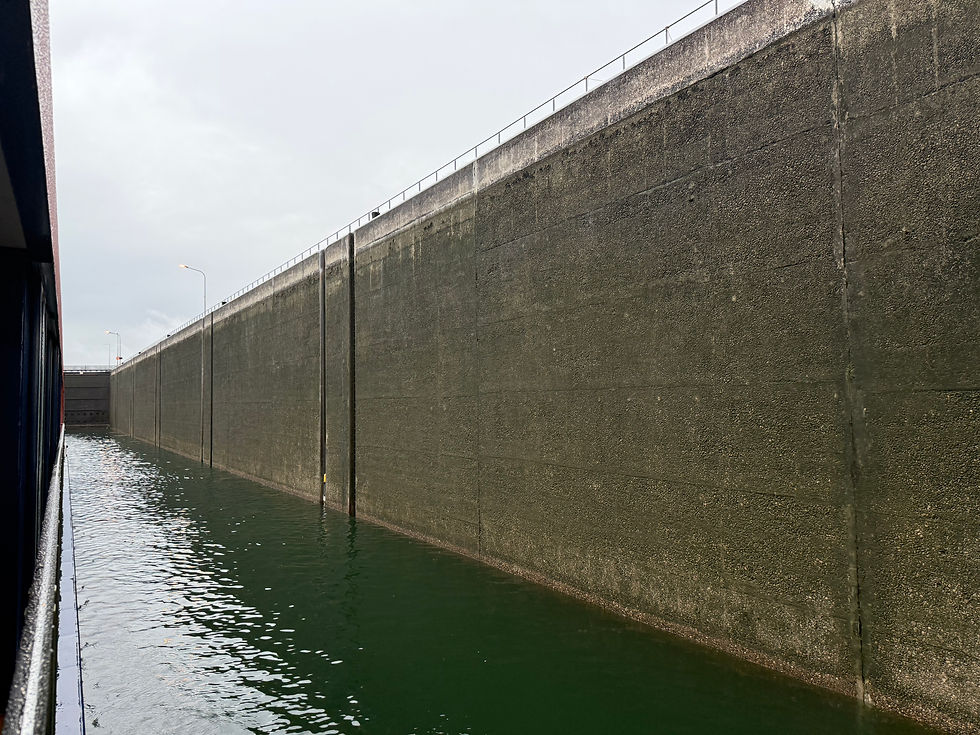
We are finally cruising on the Rhine, and it feels good. While we were told there is a lot of industry along the banks, we did see some greenery—fields and trees and such. What was interesting were the locks we go through. In the first few hours we’ve already gone through a few of them, and you hardly feel you’re rising. These photos show the progress
As the photos below show, we start out in a canal below the river, enter the lock and water is piped into the lock from the river, and the boat rises with the water. Once the lock water reaches the level of the water, the lock opens, and out we go.



This was a special dinner night for us. They have what they call the Chef’s table which is a small dining room at the rear of the boat. It holds about 20 guests with a set tasting menu.Our first course was an amuse bouche of Essence of tomato ( I skipped that course); followed by a cured lemon salmon which was quite tasty; then a delicious carrot and ginger soup; then a poached King Prawn (one); to cleanse the palette a green apple sorbet; the main course was by unanimous consent the least interesting—strip sirloin. The grande finale was a dark chocolate mouse thing with mango curd, very tasty. Each course was accompanied by its own wine. We preferred the two white and the desert wine to the red. Because there were birthdays and anniversaries in the group, we also were the beneficiaries of chocolate mouse cake. Stuffed, we called it a night.

We had docked in France but the city we are in, Breisach, is in Germany. Again, this Alsace region is somewhat schizophrenic since it’s gone back and forth from Germany to France so many times. I had a bike tour in Germany, and Betsey, Jay, and Esta were doing a walking tour in France.

The bike tour was glorious. We rode into Breisach which has a church dating back to the 13th century although the village dates back to Celtic times about 4000 years ago, followed, of course, by the Romans. The church was badly damaged in WWII, but has been rebuilt. This area was the scene of a major four-week siege during the war as the Americans came through France and met stiff resistence from the Germans.
Our bike ride took us along the Rhine on top of a berm with a well-tended bike lane. You can take this bike lane straight along the Rhine to Amsterdam, a 500 mile journey which we did not take. In the 18th and 19th centuries the river was straightened with parallel canals added to aid shiping. A series of locks and dams balance the river flow and there are artificial ponds along the side that can take on water if the river begins to flood. Pretty cool. What was cooler were the many pairs of swans floating elegantly on the river.

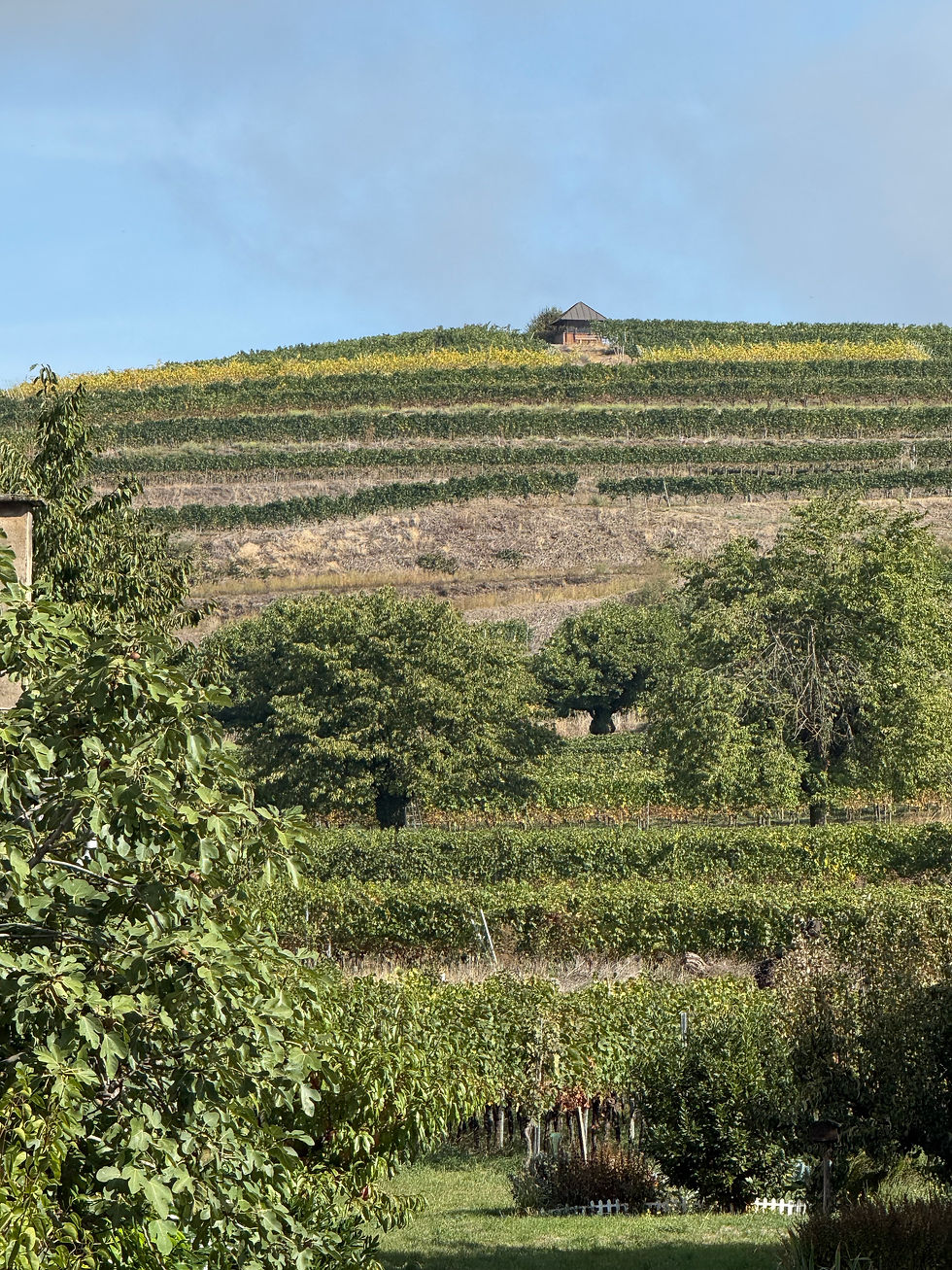
From the river we rode inland through a forest and out into Burkheim a village of 960 people
in the heart of the wine region. The village hasn’t changed in hundreds of years, and vinyards are terraced up from just outside the village. The grapes had already been picked,
We continued our ride past many cornfields, orchards of apple, peach, plum, and cherry trees, sunflowers, and lavender. A wonderful ride in balmy weather.


Meanwhile, in France the rest of my gang was in Colmar, a well-preserved town along the
Lauch River with many timbered houses and different districts that were once set aside for tanners, fishmongers, etc. A large mansion owned by a rich wine merchant had a pushed out balcony so intruders trying to enter the gate could be easily shot. It was also the home of the sculptor, Auguste Bartholdi who designed our Statue of Liberty. To commemorate the battle that took place in the area an American tank sits smack in the middle of a residential area.


We all returned to the boat for lunch and an ice cream social, and headed out late in the afternoon. Next and last stop—Basel Switzerland. As a final gesture on this cruise, the AC went out again. Another hot night ahead. We had our drinks in the lounge before dinner and had dinner with a couple from California we’ve gotten to know. The six of us did cruise “Bests & Worsts”. Speaking of the cruise, we felt the company did the best they could under the circumstances. We’re not sure if the original itinerary would have had us on buses as much and as long as we did, but that was a definite negative. Also, we tried to remember who told us to do a Rhine cruise or if we came up with the idea ourselves, but the Rhine is essentially an industrial river and the scenery is not Baroque castles on the hill or quaint villages so much as loading docks and storage towers. The excursions by and large were enjoyable and interesting to see. We just wish they were closer to the river. We leave the boat tomorrow morning for the trip to Berlin.
Enroute
Up bright and early, we had breakfast and met our driver for the hour or so ride to Zurich. As we passed through Basel we didn’t see more than some office buildings. The ride to Zurich was scenic with rolling hills, vineyards, some farmland, and fast-turning leaves. An uneventful flight to Berlin and less than an hour to our hotel—The Adlon. One common thread in the five countries we’ve been in this trip—-rampant graffiti along every highway.
Berlin
We are staying at the Adlon Hotel which is a great location very close to the Brandenburg Gate and the US embassy. I wonder if there will be anti-Trump protesters there while we’re in town.

We walked to a very good dinner at Bocca di Bacco nearby. Tomorrow we will meet our guide, Nirit who we originally used on our first trip to Berlin in 2009. She is Israeli, and came to Berlin with her German boyfriend back then. I guess we’ll learn tomorrow if the relationship lasted.
Well, Nurit did marry her German boyfriend. They had two sons and were divorced after 20 years. She is a terrific guide with many anecdotes about life and Jewish life in Berlin. We have her for two days of touring. The first day we covered a lot of Berlin history. An interesting tidbit. Berlin means swamp in German and the beginnings of the city were in the swamp. Today, when a new building needs to be built, they use an elevated 12-14” pipe that pumps the swamp water into the river blocks away so they can put in the foundation of the new building. But I digress.
We saw many things Betsey and I had seen on our first visit in 2009 which were new to the Feinsods but remain interesting to us, including the Holocaust Memorial which is so close to the site of Hitler’s bunker and Goerging’s bunker where they committed suicide on April 12 and 13th (respectively ),1945.

One particularly moving sight which we had not previously seen was where the Nazi students burned a pile of Jewish books outside the University. It is a glassed over pit in the square, and when you look down you see empty bookshelves. In the reflection of the glass top you see the university and the opera house—symbols of the lost learning and culture.

‘
We spent considerable time talking about 1961 when the Russians built the infamous wall to keep East Germans out of the western zone. Many sections of the wall have been retained for historic purposes, and there is a cobblestone line all around the city demarcating where the wall stood. We visited one section that has been kept intact with a watchtower and also a memorial of steel rods and markers in the street where East Germans were shot trying to flee.


Another section of the wall has been used by artists :


Of course we visited Checkpoint Charlie which has a totally fake guardhouse marking the crossing spot, so no photo!
In the afternoon Nurit dropped us at the Jewish Museum where we had a bite to eat and then tackled the museum which is a wonderful building designed by Daniel Liebeskind that tells the story of the Jewish people in Germany from the MIddle Ages past the Holocaust. It is intended to teach non-Jews about Jewish history as it is for Jews to remember. The exhibit has been considerably updated and more dramatically presented since we visited in 2009. Liebeskind used dramatic crossed lines and tall shafts to convey the journey and diaspora of the Jews

. One particularly dramatic exhibit features 10,000 grimacing faces made of heavy metal discs at the bottom of a dark tower.


Pretty wiped out Betsey and I Ubered back to the hotel while Esta and Jay walked. Hope to see them soon! They did show up in time for dinner in our hotel’s bistro. Next morning we set out with Nurit to cover the Jewish quarter and the story of the German Jews and the holacaust. It started with a history of Judaism in Europe. There are two divisions—the Spehardic Jews who emigrated from Spain and Portugal to Holland, Britain, Ireland, France and the US. The Ashkenazi Jews all originated in what was the central part of Prussia-Germany.. Over the course of German history the Jews were either expelled—primarily they emigrated to what is now Poland, Russia, Hungary. Hence, most of the Ashkenazi Jews ended up in the shettles of Eastern Europe, and that is why most of the Concentration camps were based in Poland—where the Jews were.
However, when the German nobility ran out of money after the Napoleonic wars, they invited 50 wealthy Jewish families to return to Germany to lend money to the government. From this group emerged a new German Jewery, people of wealth and stature. Other Jews followed to rebuild the community. The most famous Jewish philosopher, Moses Mendelssohn, came to Berlin as a young man and espoused the belief that Jews should not only study the Torah but also secular studies to become doctors and lawyers and not be under the thumb of the Rabbis. Out of this came Liberal (or Conservative) Judaism and eventually Reform. It all came out of Berlin.
Of course the next Chapter was disaster. In the late 1930’s there were about 120,000 Jews in Berlin. In 1938 they were told to leave. Those who could or wanted to emigrate did. By 1941 plans for the “final solution” were in place, and 55,000 Berlin Jews were eventually killed. Men of mixed marriages were aloud to stay and become forced labor workers; 1700 Jews were able to hide in Berlin and survive.
We visited the site of the first synagogue which was destroyed, and the site of a Jewish welfare house where the first Jews were rounded up for deportation. There is a memorial there telling the story.

The site of the first Jewish cemetery had a gruesome history. The Nazis dug up all the graves, (including Mendelsohn’s), got rid of the bones, and used the site for a mass grave for Germans killed in the battle of Berlin. Memorials mark the site.


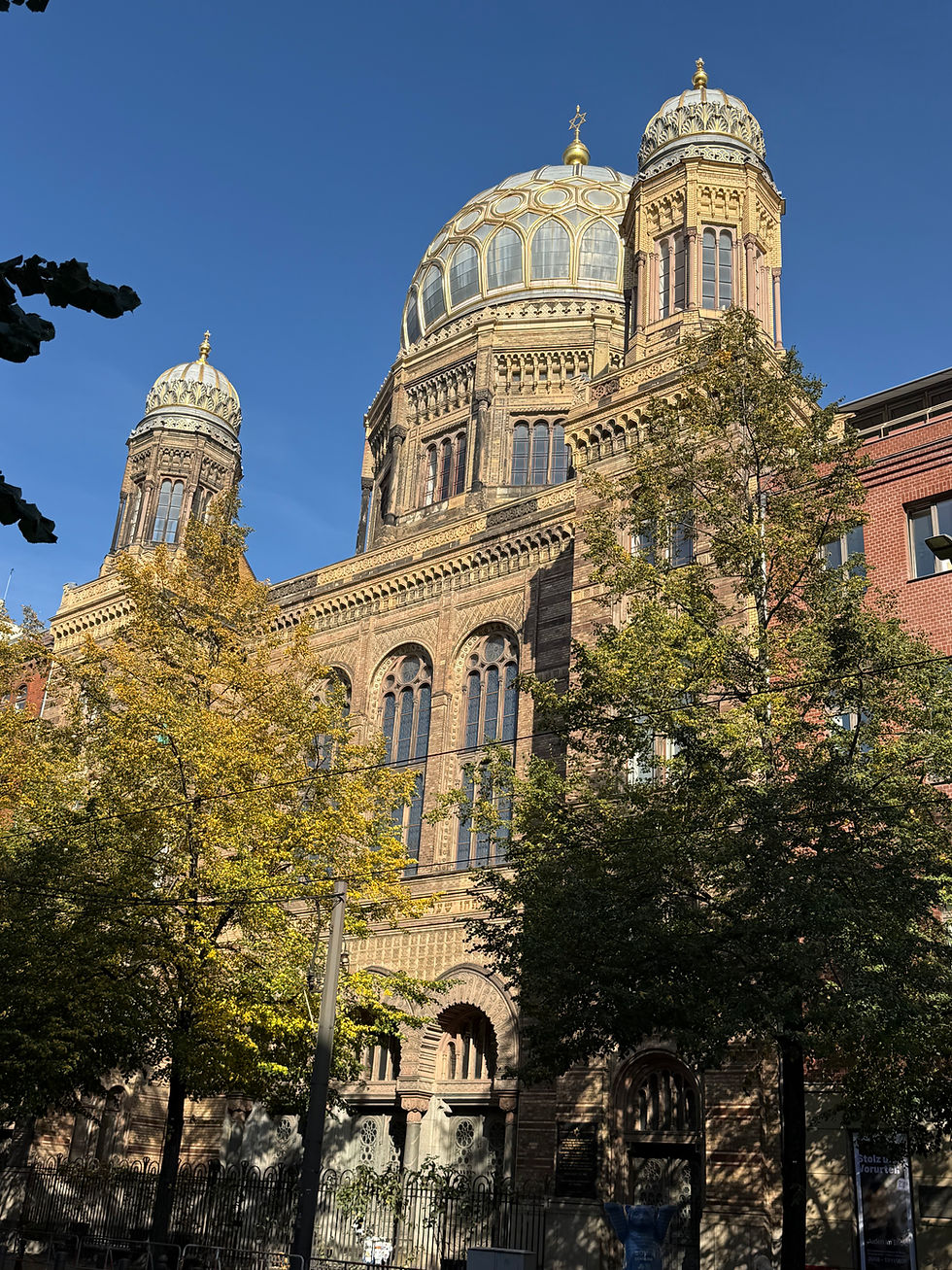
While the old synagogue disappeared, the “new” synagogue survived because it was too close to a building the Nazis wanted to keep; however, it was bombed during the war, and afterwards the East Germans destroyed the remains of the sanctuary ( which once had 3200 seats) because of bomb damage. They left the front of the building and rebuilt the dome that had been destroyed in the bombing.
In the Bavaria district, a wealthy enclave where many wealthy Jews had once lived, there is an interesting memorial. On signposts throughout the neighborhood are metal signs with a drawing on the front and a Nazi anti-Jewish rule on the back—such as Jews are forbidden to walk on this street.. A different Nazi rule on every sign. The artist wanted people to experience Nazism throughout the neighborhood, not just in one place.


Perhaps the most poignant site we visited was the Grunewald railway station from which the Berlin Jews were deported to Polish ghettos and then on to concentration camps, and later directly from Berlin to Auschwitz. Along the tracks are listed in steel engraving the date and number of Jews deported on each train that went out from the start to the end when the Russians took Berlin.


We had a good discussion with Nurit about German politics today in light of the rise of the Right wing parties. Perhaps from a somewhat biased West German/Jewish point of view Nurit said that to gain German unification the West German government promised the East Germans too much, including subsidies and parity with the Deutsch Mark which was way out of balance. From Nurit’s perspective the East Germans who were used to Socialism suddenly had to go to work. She also felt the East Germans did nothing to compensate the Jews for confiscated property on their side and still won’t make restitution. So resentment of the West and anti-semitism has led to East Germans wanting the kind of authoritarian leadership they were used to in the past. At. Least 60% of all Germans are against the Right so she is hopeful sanity will prevail.
On our own after bidding Nurit goodbye, we ended the day at a photography museum with a couple of exhibits. One, about the impact of social media on youth was particularly disturbing, so much so that I had to have an ice cream cone to recover. We had a so so dinner at Sagrantino, and to bed.
Next day, we had another sumptuous breakfast at the Adlon which does breakfast like a King’s feast from champagne and caviar to pickled eggplant and everything in between. It fortifies us for the long days of touring.

We set out on our own after breakfast for the short walk to the Reichstag, the nation’s capital. It was bombed during WWII. German unification happened in October 1990, and in 1999 the capital was moved from Bonn to Berlin and into the totally renovated Reichstag with a magnificent glass dome and new interior created by the architect Norman Foster. We walked the ramp that circles up to the top of the dome with a history lesson in our ears.


We Ubered to the Hamburger Bahnhof Museum of Art in a former railroad station which features very contemporary installations. The most interesting one was by the Lithuanian artist Lina Lapelyte using 400,000 wooden blocks to create an interactive Jenga-like space where you can build and break down the blocks while chant-like music plays and people dressed in black stand on top and chant along. It was very entertaining.


We walked back to the Adlon for some refreshments and strudel in the elegant Elephant lobby lounge.

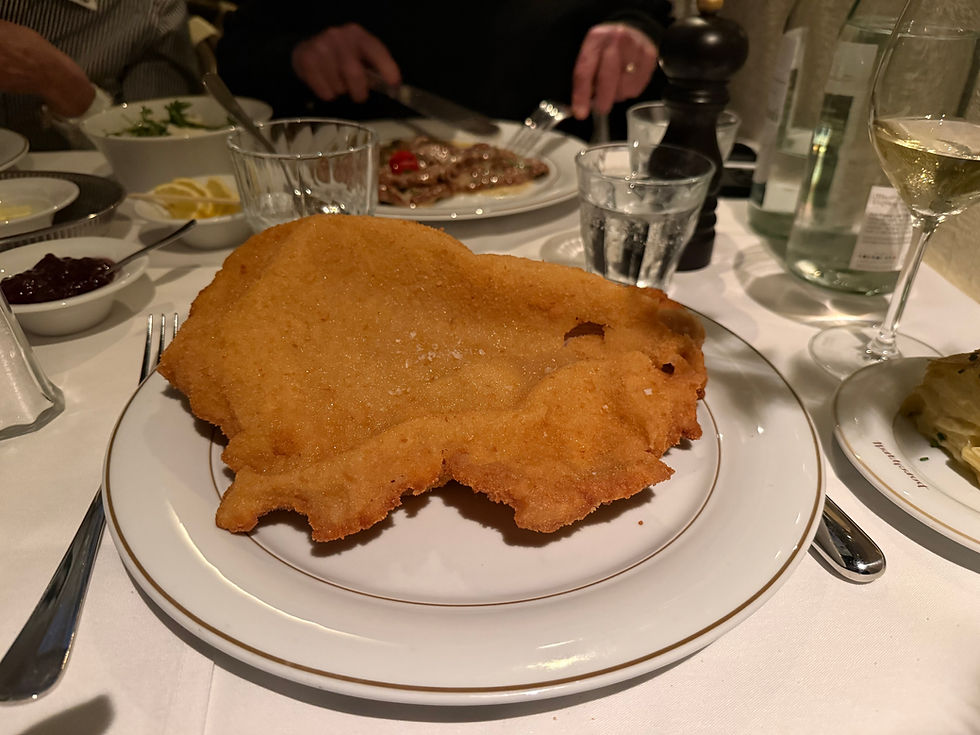
While we’re on the subject of food, we had a very delicious dinner and great atmosphere at Borchardt. It’s a very large restaurant and outdoor terrace, and on a Tuesday night it was filled to the rooftops with everyone having a good time. Fortunately, we were dining on the outdoor terrace because the din in the dining room was beyond loud. Very happy Germans. I had my first Wiener schnitzel of the trip which was too big to finish.
What better thing to do on your last day in Germany than visit a concentration camp! This brings me to an observation—every time Germans talk or write about the Nazi era they refer to it as the time of the National Socialists, Hitler’s politial party. Rarely is Hitler’s name or the term Nazi used. It’s almost as though the Holocaust was the fault of the National Socialists, and not Germans, Just saying……
This was reinforced by our visit to Sachsebhausen, about an hour outside of Berlin. While it is true that most of the concentration camps were located in Poland the farther east, this camp was created as a model for future camps, and SS guards were sent there for training. It opened in 1936 and the first prisoners were the “undesirables”—Communists, Gypsies, and Homosexuals. Later it housed Jews who were left in Germany. All told about 200,000 male prisoners passed through its gates. In its final days in 1945 33,000 remaining prisoners were forced marched to the north as the Russians closed in. Those who couldn’t march were killed. It was liberated by the Russians as the war drew to a close with a couple of thousand still in the camp, the weakest of the weak.
It was a sobering visit, a very large space that abutted up to the residential area of the town. So much for “we didn’t know anything.” The entrance has the SS slogan—Work will set you free- because those sent there were told they were going to a place where they would be given nice places to live and jobs. Of course, they were sent to the nearby factories as slave labor before they became to weak and ready to be killed.

Main entrance to the camp


The barracks no longer exist except for outlines of stones, but there are remnants of the Jewish barracks which were firebombed by neo-Nazis shortly after Itzhak Rabin paid a visit. You can see the scorch marks on what remains.
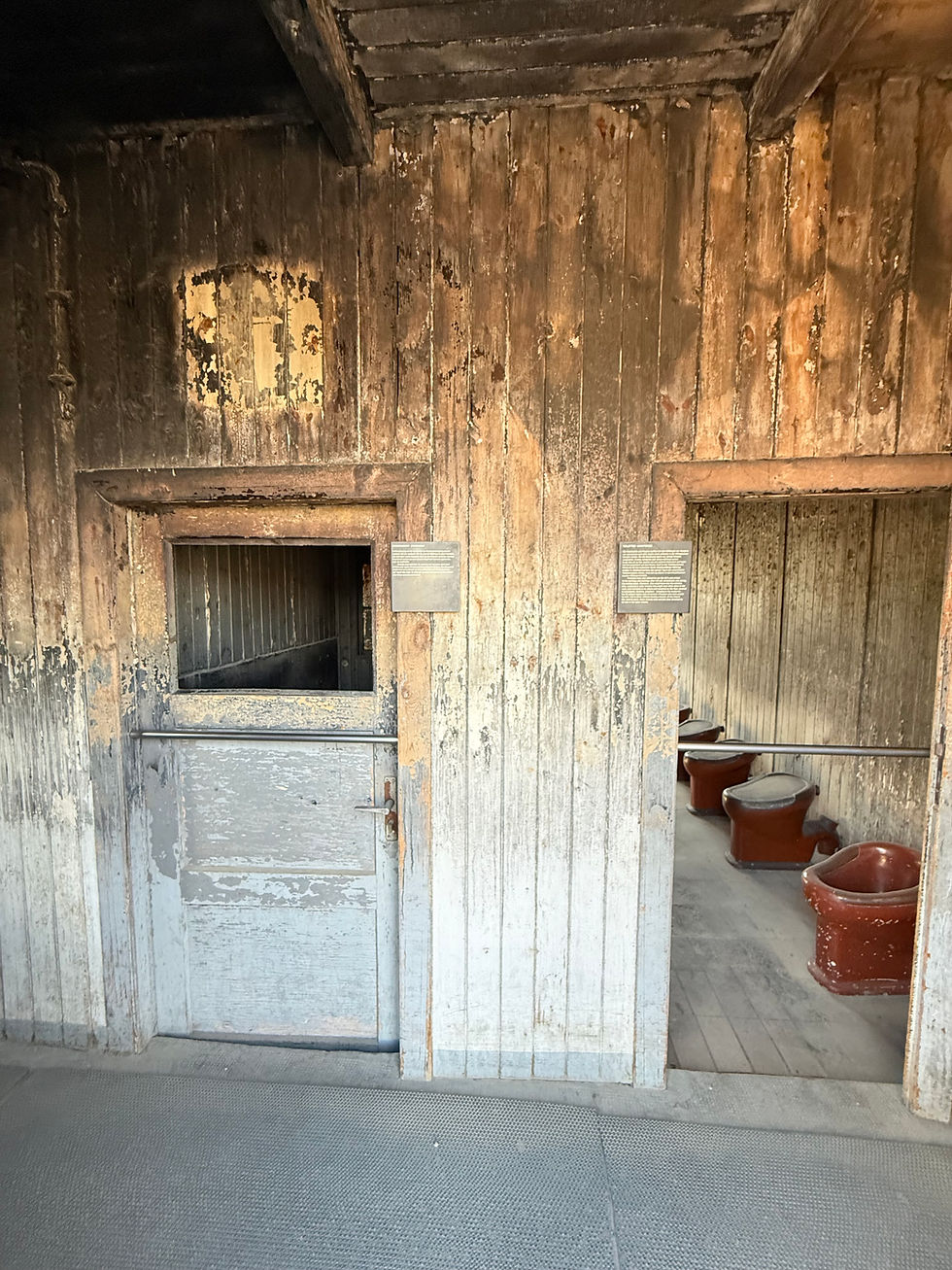

The cells for Gestopo political prisoners.
In the early days of the camp killings were mostly by shooting, but as the SS became more sophisticated and the need for a more efficient killing system was needed, they turned to the gas chambers. What remains is the outlines of the gas chamber and the ovens. The bones and ashes were collected and dumped in a nearby river.


A memorial to the dead faces the gas chamber.
Perhaps it was beshert that we visited the camp on October 7 because on our return to Berlin there was a very poignant commemoration of the Hamas killings. The German Jewish Student Union used the square in front of the Brandenburg Gate to place very long tables and chairs in a U shape with photos of those killed at each place and a brief description of who they were and how they were killed. There was a strong police presence and a lot of people visiting the site.


In memory of the Hamas massacre of October 7th. When we returned from our last dinner.
And so our visit to Berlin comes to a close. For Betsey and me this was our third visit to Berlin and many visits to other German cities during my work years, so this will be our last visit to Germany. This was a very good trip, but it’s time to go home.
PS- We had a delicious, somewhat exotic Mediterranean dinner at Night Kitchen, led by an Israeli chef for our last dinner in Berlin.


Comments