Christmas in the Amazon
QUITO, ECUADOR, December 21-27, 2025
Apparently, the quickest way to get to Quito, Ecuador from Los Angeles, is to fly through Miami. So that’s what we’re doing. We are headed to the Amazon for Christmas! The Amazon had been on our bucket list, but we weren’t eager to do a long boat trip. Our friends, Iva and Danny, had the answer. Last year they went to an eco camp deep into the Amazon in Ecuador and loved it. So we are taking their word for it and heading there along with friends, Esta and Jay who are always up for an adventure.
We flew to Miami on December 18 and spent a couple of days visiting relatives and Stamford friends. It’s so rare for us to be on the east coast of Florida. We met Esta and Jay at the gate for our flight to Quito on the 21st. The 4-hour flight was packed but uneventful and we Ubered into the heart of the old town of Quito and got to our hotel 45 minutes later. Casa Gangotena is a converted mansion on one of the main squares overlooking the San Francisco Church and Monastery. Incidentally, the old town has 52 churches, many of them quite heroic in size and stature. Built in the early 1920’s on the ruins of a fire-gutted prior mansion, the hotel is beautifully detailed and filled with roses (one of Ecuador’s main exports). We were soon to bed and a sleepless night getting used to the high altitude.
After breakfast and a brief Avon zoom meeting we walked the old town. The Spanish colonial architecture is reasonably well preserved and quite beautiful in the facade details.
The streets are clean but the poverty is noted everywhere. Not so much in homeless people but everyone is a hawker of trinkets and trash. The streets echo with their chants and bellows. They are not aggressive but omnipresent.

We sat a while on the main square with the presidential palace and plentiful army protectors surrounding it. One very strange occurrence. An old woman ( we think, as the dress was a bit obscure) wearing a tallis kept blowing on a large shofar (ram’s horn) with Yom Kippur-like repetition. Very strange indeed.

We stopped for lunch at a charming restaurant La Vida and then wondered back to our hotel for some rest before dinner. Not to talk only about food, but we had an elegant and tasty dinner at our hotel that was unique in many ways and well served.
Up and out early, we headed to the airport. Quito’s 1.8 Million population is arrayed on the many hills surrounding the city, very much like Caracas. Poverty seems endemic with one small hut piled on top of another. We flew a half hour to El Coca, named for its famous cocoa trees, which has become the center of the Amazonian oil industry, now the country’s biggest business.
A short bus ride brought us dockside where we boarded long-boat motorized canoes for the next leg of our journey down the Napo River.

It was two hours on the Napo river which is a large tributary into the Amazon river. It is bordered by rain forests, thick and dense and sand bars with driftwood dotting the shoreline.
We pass small indigenous settlements consisting of a thatch roofed hut with a canoe out front on the river. We also pass barges which are used to ferry the oil to tankers and ultimately passage over the Andes to coastal refineries. After two hours we paused for a bathroom break and then took a short walk to long-boat unmotorized canoes.
Our paddlers used leaf-shaped paddles which mimic a local broad-leafed plant. Finally we arrived at La Selva Lodge on a lagoon. It has thatched-roofed cabins and a comfortable lounge and dining room with accommodations for about 50 guests. They created a pool by boxing in a section of the lake which doesn’t seem that appealing.


The head of guides gave us an orientation to our stay. Like African safaris we will go out twice a day on excursions—very early in the morning and late in the afternoon to avoid the searing mid-day heat. Trust me, it is searing heat with high humidity.
Since we had had a box lunch on our motorized canoe ride we headed right out for an excursion after Oscar, our guided fitted us out in rubber boots.
We are in one of the richest biospheres in the world which means there is more diversity of species than almost anywhere. Yet, there is scarcity exactly because there are so many species vying for survival. We cannot expect to see big animals on this trip since they are rare and rarely spotted. However, almost as soon as we pushed off from the dock we enjoyed a troupe of squirrel monkeys flinging themselves from one tree to another as they grabbed their leaves of choice. They almost seem to be flying from tree to tree. It was a fun sight. We also spotted various birds ably guided by Oscar and our local native guide who has incredible talent for spotting.

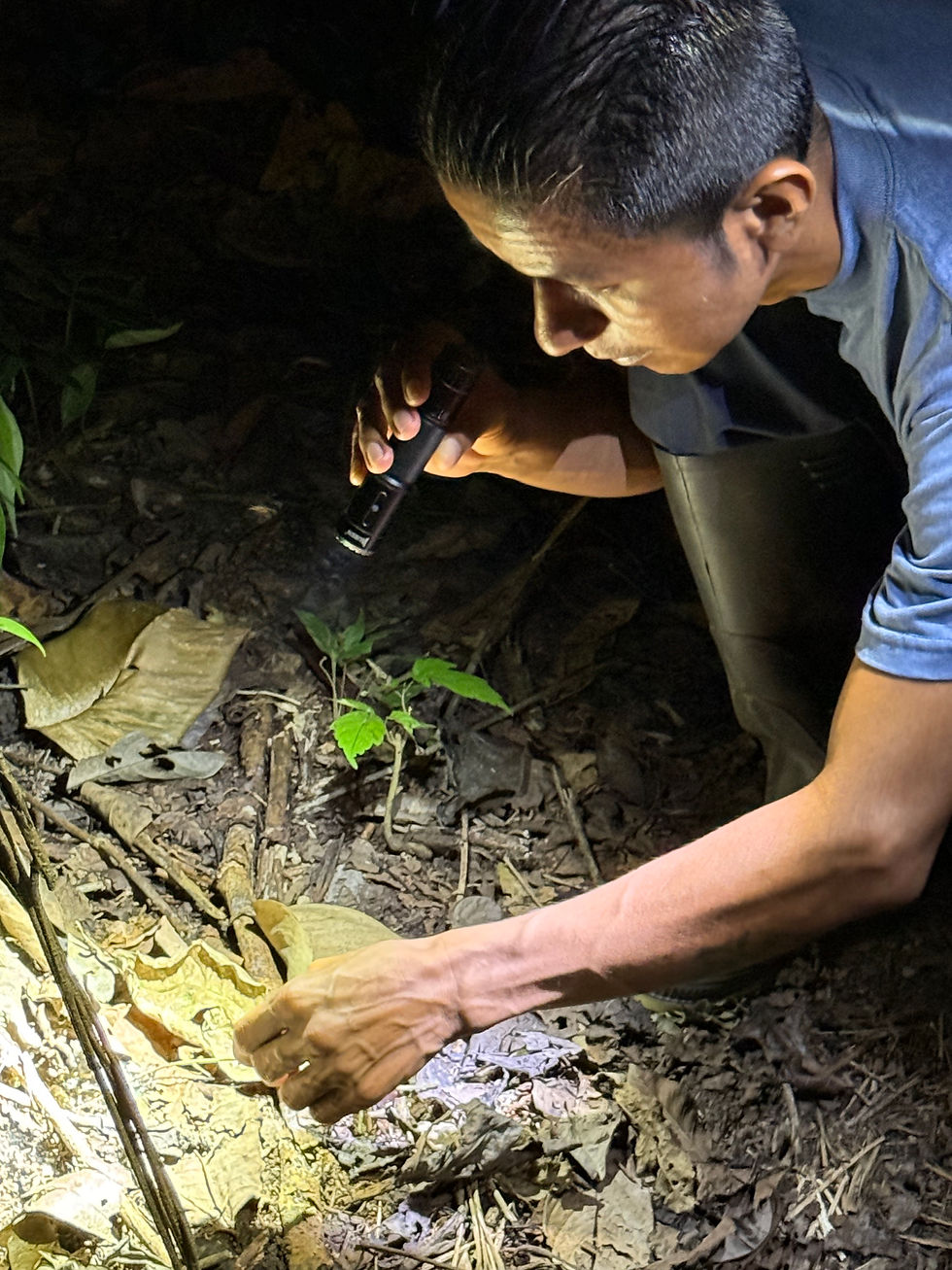
After about an hour on the river, the sun went down and we docked for a hike through the forest along a very narrow and dark path. Our guides spotted and pointed out all manner of insects and tiny specimens, including tarantulas and crickets and lizards that look so much like the branches they sit on that you almost have to touch them and see them jump to know they are real.


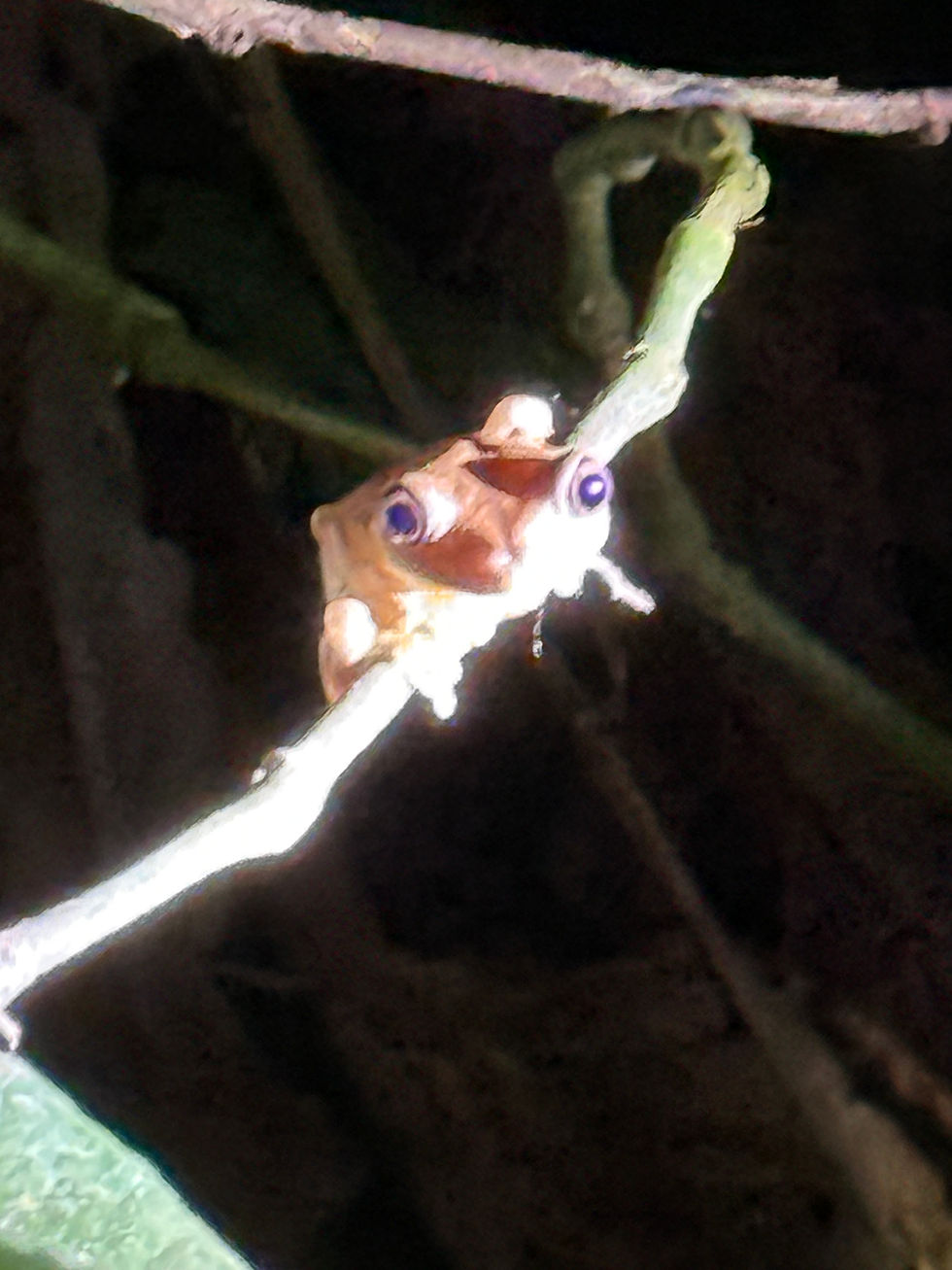
Some interesting tiny frogs were also staring up at us as we lumbered through the woods.

One botanic wonder was a Kopak tree that could easily rival our redwoods.

I have to say it was not the most pleasant of walks with insects circling our bodies and the jungle pressing in. At the end I felt so grimy, hot, and bothered that I ran for a shower which never felt so good. It was dinner thereafter and to bed. Reveille is at 5:30!
Promptly at 6:30am we took off in our canoes, across the lake and into the channel to rendezvous with our motorized canoe. We were headed to see parrots who congregate above the clay slope that contains a salt-like substance that the parrots use to cleanse their stomachs. However, although we saw thousands of the green parrots flying above and nesting in the trees about the slope, no one took the bait. Apparently there was something, a snake perhaps, that cautioned them away from their remedy, and so eventually we moved on.

Our next stop was to a community of indigenous people known as the Kychwa. Here the women do the heavy lifting in terms of cooking all the food, working whatever fields they can scratch out of the forest, and overseeing the family. The men do the fishing and many work at our lodge. We learned how to blow darts although we missed the target by a lot.
Along the way we saw Stinky Turkeys for the first time. These birds are large turkey-like but smell badly because they have two stomachs and the digesting fermentation stinks.

Fortunately, we did not get close enough to test that moniker. White herons and large blue butterflies were more attractive to spot. And there were more monkeys and turtles. A cloud cover most of the morning made the temperature benign.
I have written mostly of the critters we’ve seen along the way, but I should say that the forest itself is a sight to behold. There are 25,000 species of plants in this region, including 64 varieties of bamboo alone. The landscape is a mosaic of intertwined fauna from Redwood-like trees, fresh water mangroves, ferns and all manor of palms and vines. Exotic flowers pop out now and then as well.
Our afternoon excursion was under mercifully cloudy skies. It was a monkey festival since we saw squirrel monkeys, night monkeys, and Capuchin monkeys and also heard but did not see Howling monkeys.
We spotted three very tiny bats on a stick in the water which looked so much like the sticks we had to get within six inches to see them.

Our guides have eagle eyes. However, their eyes failed them as it got dark and we went looking for alligators. Our guides scanned the shoreline with a flashlight looking for the alligators’ protruding red eyes. He claimed to have spotted a small one, but he may have been humoring us. We headed for shore to celebrate Christmas Eve dinner with a buffet and a visiting Santa Claus. At dinner Oscar, our guide, lamented the lack of tourists. Our hotel holds about 50 guests but we were only about 30 at best, and this is high season. Oscar said that the Pandemic killed the whole tourist industry, and it has never fully recovered, not the least because of publicity about crime and drugs. We saw neither.
Our first excursion on Christmas Day was on land. It turned out in total to be only a little more than 2 miles but it felt like much more, traipsing through the rain forest in hot muggy weather. But it was an adventure. We hiked to the base of a huge Kopek tree where a 200-step steel tower took us to the tree tops as we stepped onto a platform nestled into the top branches of this formidable tree.
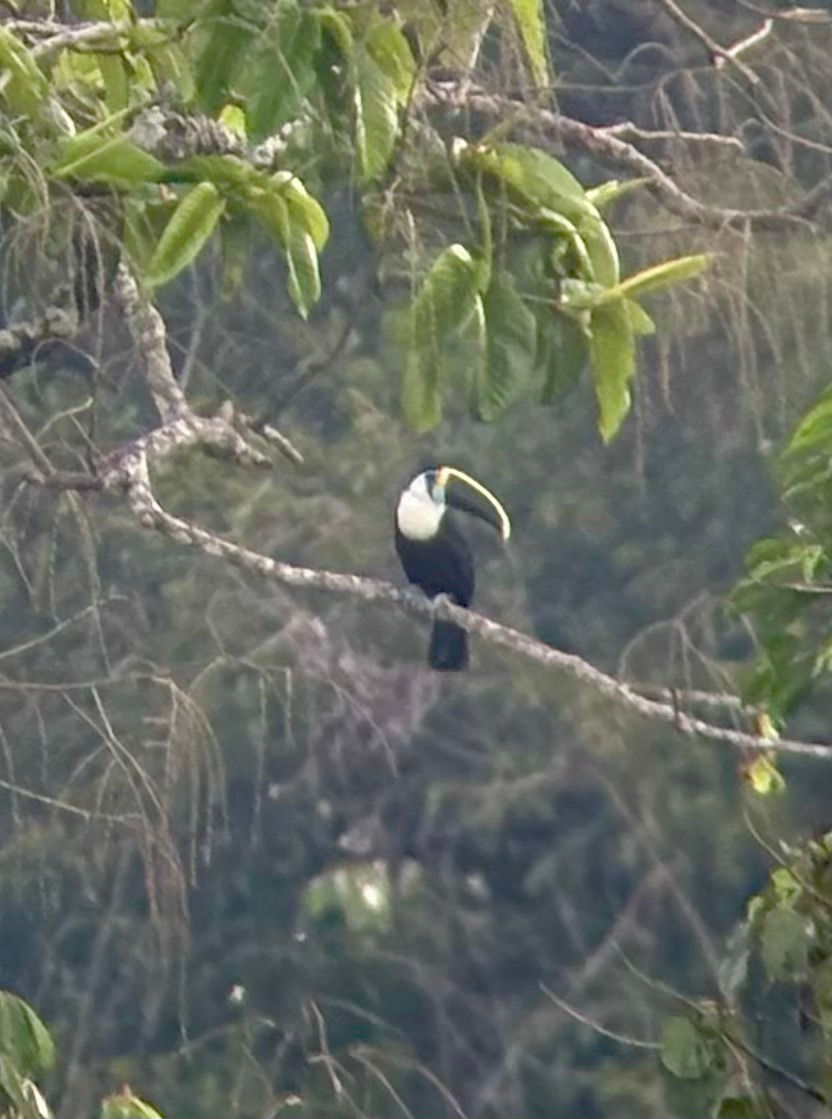
First thing I noted were all the bromeliads and orchids (not blooming except for one) that had found a home on the tree limbs. Then it was bird-watching time. We saw several birds we had not seen before, including a Toucan and a large parrot.

A special treat was spotting a howler monkey scampering in a nearby tree. He was really large, almost chimpanzee size I would say and a rust brown and dark brown color. A good spotting.
Then 200 steps down for more hiking to another lagoon, smaller and filled with water Hyacinths. We canoed along a man-made channel for a while looking for alligators to no avail. Our native guide, Dario, can spot the most invisible critters which we then learn about. Tiny frogs that are hard to see even when staring up close; he spots and catches them in an instant. One of the frogs “sweats” a poison that was used on the tips of arrows to paralyze opponents. On a more beneficial note Dario shows us a liquid cut from a tree that is a perfect antidote to bug bites and acne. Then it was a hike back to our lodge and long showers to wash off the heat.
Our final afternoon excursion was uneventful. Lots of squirrel monkeys and some howlers and birds but no alligators, jaguars, or ocelots that apparently can be found in this region. Again we are told- great biodiversity but scarcity of each species. We had a final dinner and were told wake up for our departure will be 4:45am, and so to bed.
Nect morning, not to miss a single thing, a young guest pointed out his new best friend, Fred the tarantula.


We left the lodge on the dot of 5:45 am (this is getting old) for our half-hour canoe and two-hour motorized canoe rides back to El Coca and the flight to Quito. We are staying a the airport Holiday Inn and Jay and I had burger lunches to ease our transition back. The ladies with soup and salad. We camp here until tomorrow when we take a 4am shuttle to the airport and our flight to Florida and for Betsey and me, Connecticut for an expected 8-10” of snow. Wish us luck!
Thinking about Amazon experience, I’d have to say it isn’t Africa where excitement and wonder came around every corner. Bugs and Monkeys aren’t lions, elephants, giraffes, etc. But what does impress and amaze is how unique nature is. When you are six inches away from a tree branch and you can’t spot three tiny bats on the branch because they are the exact same color, you appreciate the ways of biology. When a particular variety of black bird follows troupes of monkeys to munch on the monkey’s leftovers, that’s nature. And the expanse and variety of plants, trees, flowers, vines, make for a pretty dense and beautiful tapestry of green. So, we’re all happy we came and fulfilled this bucket-list item.
Dinner was at our Holiday Inn hotel and we capped it off with “Bests & Worsts” of the trip and to bed. Up before 4am we flew to Miami and an on-time connection to NYC, arring home at 6:30. We had gone from 90 degrees to the 20's in one day, but we are home.


Comments